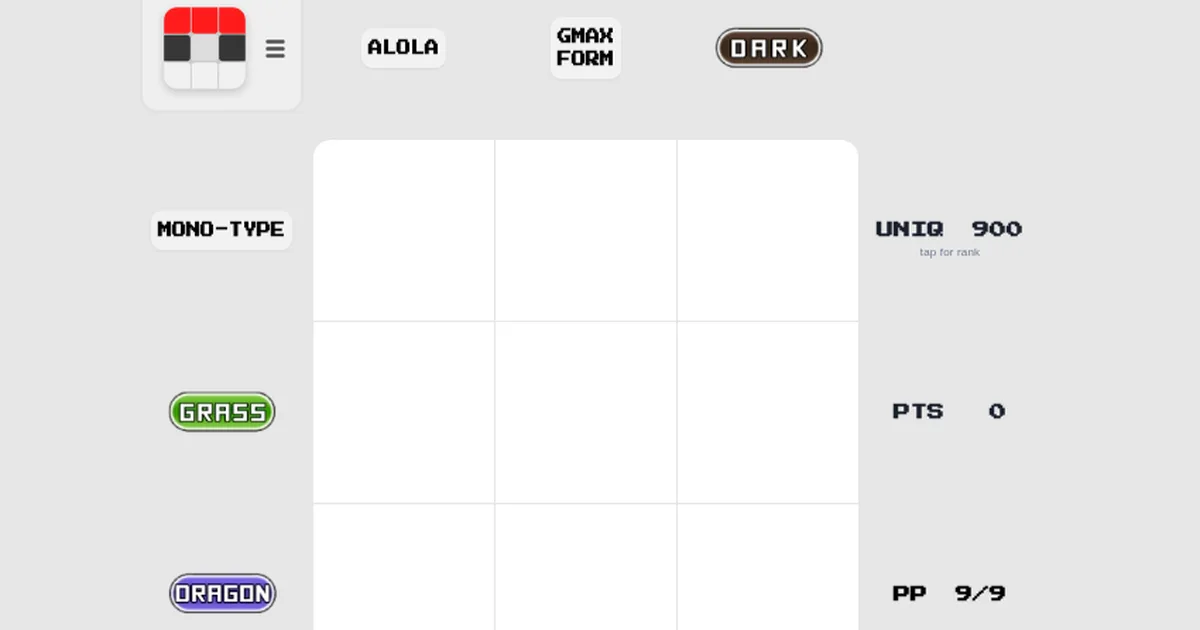
What is PokeDoku?
PokeDoku is a daily Pokémon trivia game made by Doku Games. Every day there is one new 3×3 grid with three categories across the top and three down the side. Categories can be a type (Fire, Grass, Dragon), a region (Kanto, Johto, Alola), a group (Legendary, Mono-Type) or a form (GMAX, Mega). For each of the nine boxes you name one Pokémon that fits both its row and its column. If the column is Water and the row is Johto, Totodile, Croconaw or Feraligatr all work.
Everyone gets the same grid on the same day, so it works like Wordle: play once, compare your result and share it. The puzzle resets at midnight Eastern Time.
How to play PokeDoku
- Open pokedoku.com and look at today's six categories.
- Click an empty box and type a Pokémon name. Pick one that matches the row and the column.
- Your answer locks in. A correct answer shows its sprite; a wrong one still costs a guess.
- You have 9 guesses (PP 9/9) for 9 boxes, so every miss means one box stays empty.
- When you are done (or press Give up), you see your score and how rare each answer was.
The official rules, explained
Core rules
- One Pokémon per box, and it must match both categories.
- No reuse. Answers lock in and a Pokémon cannot be used twice. The official example: Charizard fits Flying + Fire, but if you already used it, you need another Pokémon.
- Most boxes have several answers, except in Master and Fan puzzles.
- Type categories only need one matching type. Dual types count for both.
Regions and forms
- Region categories use the region where a Pokémon originated (debuted).
- Unova does not include Pokémon from The Indigo Disk DLC.
- Regional forms with a region at the end of their name count for the region where that form debuted (for example, an Alolan form counts for Alola).
- Mega and GMAX Pokémon count for their base Pokémon's debut region.
- Mega categories do not include Primal forms.
- Any other form that debuted in a different region than its base Pokémon counts for both regions.
Scoring
Your uniqueness score adds up the percentage of players who chose the same Pokémon as you for each box. Lower is better. Before you make any guesses, the counter shows 900; correct, rare answers bring it down. Categories are based only on the core series Pokémon games and Pokémon Champions.
Strategy tips for a better score
- Solve the hardest box first. Look for the pair of categories with the fewest possible answers (a form category against a type, for example) and fill it while you still have all your Pokémon available.
- Don't burn a rare answer on an easy box. Because Pokémon can't be reused, save Pokémon that fit narrow categories for the boxes that need them.
- Avoid the obvious pick. Starters, Pikachu and Charizard are what most people type, so they score badly. A middle evolution or a less-used Pokémon of the same type scores much lower.
- Remember dual types. Only one type has to match, so a Water/Flying or Grass/Poison Pokémon can solve more boxes than you think.
- Check the debut region. Cross-generation evolutions trip people up: Pokémon like Magnezone or Togekiss debuted in Sinnoh even though their families started earlier.
- Use a type chart when you are unsure what types a Pokémon has. Our Pokemon type chart and type calculator help.
- Spell carefully. A typo can cost a guess, and you only have nine.
Daily answers?
We don't publish daily PokeDoku answers. Each box usually accepts many Pokémon and the grid changes every midnight ET, so an answer list would mostly spoil the fun and push everyone to the same, high-scoring picks. Use the tips above and the type chart instead.
Is PokeDoku official?
No. PokeDoku is run by Doku Games LLC, which states it is not affiliated with Nintendo and does not own any Pokémon trademark. Pokemon All 22 is a separate unofficial fan guide with no connection to Doku Games.